
Time system guide
The Blood of Dawnwalker Time Limit Explained
How the 30-day time system works, what advances the clock, whether exploration costs time, and why one run cannot cover every story.
On this page 7 sections
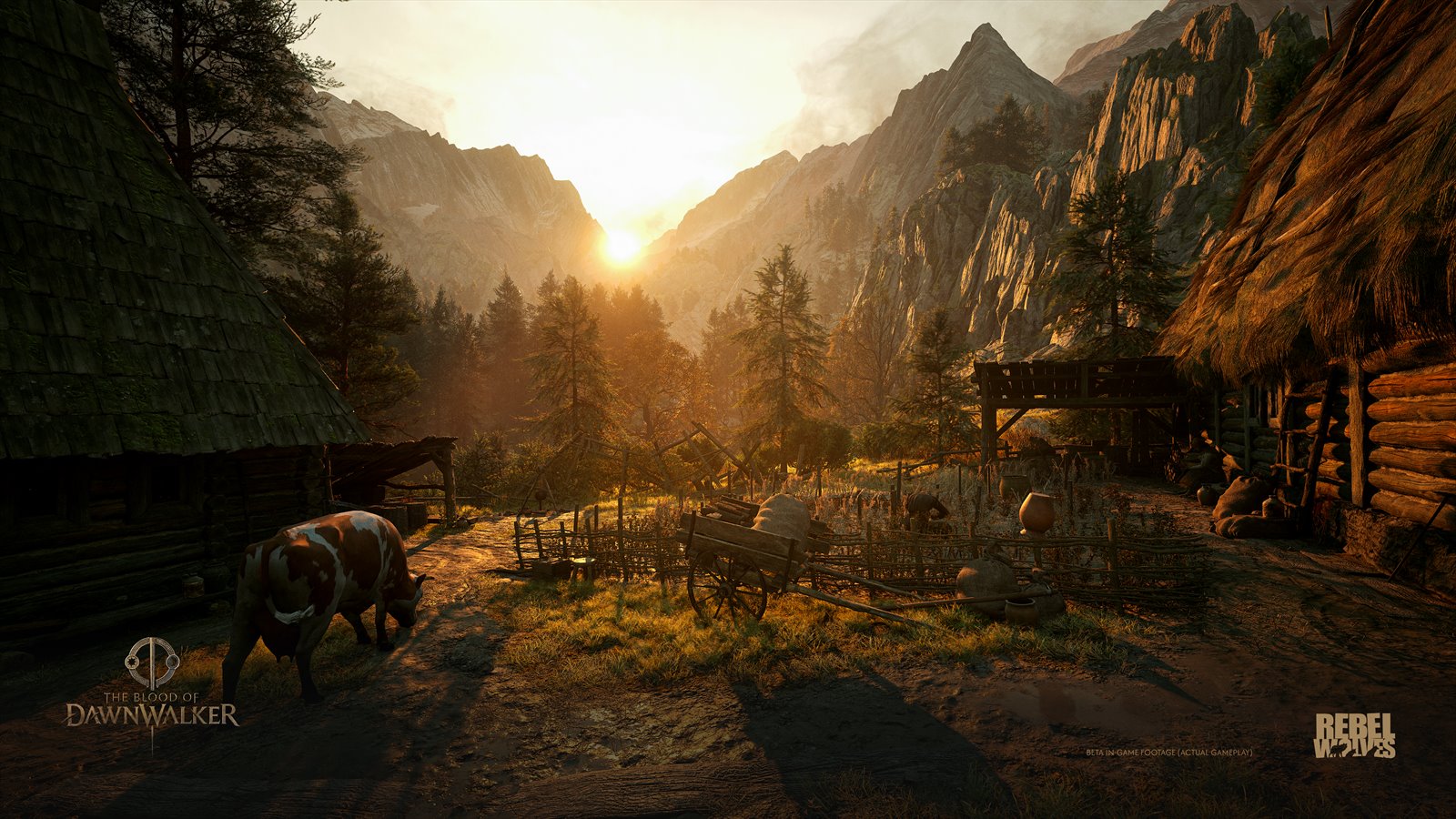
Official Vale Sangora screenshot illustrating Dawnwalker's changing time of day. © Rebel Wolves / Bandai Namco Entertainment. View media credits
The calendar advances at time-costing actions and story triggers. Free roaming does not continuously drain the deadline, but approaching certain events can move the clock; watch for warnings before proceeding.
How does The Blood of Dawnwalker's 30-day timer work?
After the prologue, Coen has 30 days and 30 nights to rescue his family. Each daytime period contains eight segments and each night contains another eight, giving a theoretical campaign budget of 480 segments.
This is not a real-time countdown. The clock waits while you explore Vale Sangora and moves when you commit to a marked activity. The number beside the hourglass shows the cost before you confirm it, so the real decision is whether a quest step, conversation, training choice, or discovery deserves part of the remaining budget.
The central rescue objective changes when the last segment is spent.
Eight daytime segments followed by eight nighttime segments.
Roaming and scouting do not run a stopwatch in the background.
The story continues, but failing the rescue has major consequences.
What advances time?
Time can be spent by individual actions inside a quest rather than by the entire quest at once. The launch build uses an hourglass plus a number to show how many segments an action will consume.
Actions reported to use time include:
- Important quest steps and resolutions
- Selected dialogue choices or interventions
- Some world events, treasures, and points of interest
- Relationship scenes and character activities
- Learning or upgrading certain abilities at Shrines
- Deliberately waiting at a Shrine
The same category can contain both free and paid actions. Reaching a bandit camp may be free, while resolving the activity inside it may spend time. A conversation can be free until one response commits Coen to staying, helping, or escalating the situation.
Watch for story triggers: GamesRadar's completed-game guide reports a ticking sound and greyed clock segments near some locations or NPCs that advance time on approach. Stop at that warning and check the cost before moving closer; a dialogue confirmation is not the only way to spend time.
See GamesRadar's time-system walkthrough for these proximity warnings and examples of quest costs split across several steps.
What can you do for free?
Current launch-build coverage confirms that ordinary movement does not spend narrative time. That means you can scout first and pay later.
- Explore the open world and uncover map routes
- Inspect clues and listen to ambient conversations
- Manage inventory, equipment, and day/night loadouts
- Fight ordinary enemies and wildlife
- Use unlocked fast-travel points
- Read the Journal and compare objectives
- Postpone an untriggered activity, provided its deadline and story conditions allow a return
Free exploration is the game's pressure valve. Use it to find several opportunities before deciding which one deserves a segment. Reaching a story trigger is different from ordinary travel, and free travel does not guarantee that a postponed quest will remain available.
What do the time icons mean?
- Hourglass + number: completing that action immediately spends the displayed number of segments.
- Clock beside a quest: the objective has its own deadline or time-sensitive state; check the Journal before postponing it.
- Sun: the activity or route is available during the day, when Coen uses his human toolset.
- Moon: the activity or route is tied to night and may require vampiric abilities.
Costs carry across the boundary between day and night. If one daytime segment remains and an action costs three, the action uses that final daylight segment and two nighttime segments.
A practical time-management plan
- Reveal the area first. Climb towers at night, visit settlements, and collect quest leads before committing.
- Open the Journal whenever a new quest starts. Clock-marked objectives outrank activities with no visible deadline.
- Bundle day-only or night-only work. Avoid waiting just to change form when another useful action can move the clock for you.
- Read every hourglass. A small interaction can cost more than expected; even getting caught stealing in the prologue can waste four segments.
- Use free travel and combat for preparation. Gather XP, blood, equipment, and route knowledge without burning the story budget.
- Save before high-cost decisions. The cost is clear, but the downstream story consequence may not be.
- Do not plan to clear the whole map. The game intentionally contains more opportunities than one ideal run should consume.
For the first day's time-sensitive route, follow the prologue quest-order guide.
When making your own schedule, record the next action, its displayed cost, the required day/night phase, and any deadline. A whole-quest total may cover several separate steps. Keep an unknown cost unresolved rather than counting it as zero, and recheck the Journal after each story change. Spare segments alone do not establish that a route is still available.
What happens after Day 30?
Reaching the deadline does not erase the save or force an immediate restart. The campaign continues, but Brencis follows through on the threat against Coen's family. The main motivation then shifts from rescue to dealing with the outcome.
That makes Day 30 a narrative failure state rather than a conventional “game over.” Players who want the successful family outcome still need to complete the central objective in time, while players who miss it can continue and see a different branch of the story.
30-day time-limit FAQ
Does time pass while exploring or standing still?
No. There is no continuously running real-time clock during free exploration.
Does fast travel use a segment?
Launch-build testing reports that fast travel itself is free. A quest step at the destination may still have a cost.
Does combat advance time?
Ordinary combat does not automatically spend narrative time. Completing a marked camp, event, or objective can.
Can you wait until night?
Yes. Shrines can advance the calendar, but it is often more efficient to complete a useful time-costing activity that moves the clock toward the phase you need.
Can quests expire?
Yes. The clock icon marks quests with time-sensitive conditions. Some people and events do not wait forever.
Can the timer be disabled?
No launch setting that removes the narrative calendar has been documented. Difficulty settings can change combat pressure, but the time-budget structure remains central to the campaign.
This is a sourced guide, not this site's independently tested playthrough. On September 6, 2026, we added reported proximity-trigger warnings and clarified the limits of planning from quest totals. Exact costs can vary by quest choice, so check the game's current prompts and Journal before each action.
Continue by topic
Related guides
The Blood of Dawnwalker Gameplay Explained
How Dawnwalker's 30-day narrative sandbox, day and night forms, quests, combat, exploration, and progression work.
Dawnwalker Beginner Guide: Best First-Hour Tips
Practical launch tips for Dawnwalker's 30-day clock, prologue route, Perfect Block combat, day/night builds, blood healing, skills, and missable quests.

Dawnwalker Romance Guide: Anca, Crake & Lacra
All three Dawnwalker romance options explained: Anca, Crake (Marat), and Lacra, with quest chains, time costs, route locks, fail states, and epilogues.